


What about tearing during birth?
Perineal tearing during birth is common – up to 9 in every 10 women experience some sort of tear, graze or episiotomy (a medical cut in the perineum) during vaginal birth. These generally heal quickly.
Severe tears are less common (3 – 4 in every 100 women) these are deeper and involve the muscles that control the anus. Having a severe tear can increase your risk of pelvic floor dysfunction (PFD) symptoms, including difficulty controlling your bowels (wind and poo).
When your baby is close to being born, their head will slowly stretch the vagina and perineum with each contraction. The vagina gradually widens and becomes very thin as the baby’s head starts to be born. A tear can happen spontaneously as the baby stretches the vagina and perineum during birth.
What about a cut, instrumental birth and induction of labour?
Click on the picture below for further information about having an episiotomy during birth.
Translations in Arabic and Turkish: الترجمة العربية and Türkçe çevirisi
Episiotomy
An episiotomy (ee-piz-ee-o-tom-ee) is a surgical cut made by a midwife or doctor with your consent into the perineum and vaginal wall to make more space for your baby to be born. The perineum will be numbed with local anaesthetic to limit pain.
It is not possible to know in advance who will benefit from having an episiotomy. It is important to know that having one will not harm your baby.
If you have had an episiotomy, you will need stitches to repair it. This is normally done using local anaesthetic in the room where you had your baby.
Episiotomies are not done routinely and may take longer to recover from than a minor tear. They are common, 1 in4 women having a vaginal birth (2018-19) have one. This could be done because your baby’s heartbeat drops and they need to be born quickly, or the midwife sees signs your perineum is going to tear, or if you are having an instrumental (or assisted) vaginal birth.
Instrumental (assisted) vaginal birth
An instrumental (assisted) vaginal birth is when forceps or a suction cup (ventouse or kiwi) are used to help your baby to be born.
When forceps in particular are used the risk of a more extensive tear increases to around 11%. An episiotomy is highly recommended with an assisted delivery to help prevent more extensive tears to your perineum.
Severe tear rate:
- 3 in every 100 women having a vaginal birth
- 6 in every 100 women having a first vaginal birth
- 4 in every 100 women having a ventouse birth
- 8-12 in every 100 women having a forceps birth
Urinary incontinence (leaking wee) is not unusual after birth. However, it’s more common after a ventouse or forceps birth.
Women who have had a vaginal birth before are less likely to experience a severe tear or an instrumental delivery compared to women who are having their first vaginal birth.
Your doctor will only recommend an instrumental birth if they are concerned for you or your baby.
Few birth outcomes, including instrumental birth can be predicted during pregnancy. Please read the section below about ‘encouraging a spontaneous birth’ to hear what the research says about what choices you can make to encourage a spontaneous birth?
Please read these useful guides written by women and specialists below to understand episiotomy, instrumental birth and your choices further.
Assisted or instrumental birth further reading RCOG
Induction
If you are recommended or choose induction (a medication intervention to artificially start your labour) consider the following; the reasons for induction, when/where and how induction will be carried out, the arrangement for support and pain relief, the alternative options if you choose not to have an induction and balance the benefits with the risks of this process.
Reasons for induction could be:
- medical (a risk to you or your baby) – for example your baby is very small and the placenta is not functioning well. Not being induced could seriously impact you or your baby’s wellbeing
- recommended – for example diabetes or going past 42 weeks pregnant. Not being induced could increase the risk of complications, weigh these in balance with the risks of induction.
- non-medical – such as asking for an induction rather than waiting for spontaneous labour. Consider the risks of induction when making your choice.
Your obstetrician and midwife will discuss the benefits and risks that are personal and individual to you and your baby. Read the section on ‘Making decisions about my individual care’ for ideas of structure for these conversations.
Induction will affect your birth options and experience of the birth process. This could include:
- a higher number of vaginal examinations to assess the cervix before and during induction, to determine the best method of induction and to monitor progress.
- Your choice of place of birth will be limited, as you may be recommended interventions (for example, oxytocin infusion-drip used during some inductions, continuous monitoring of your baby during the labour and epidurals) which are not available in home birth or in midwife-led birth units.
- there may be reasons why you cannot use the birthing pool.
- There may be a need for an assisted vaginal birth (using forceps or ventouse), with the associated increased risk of severe tear.
- Pharmacological methods of induction can cause hyperstimulation- when your uterus contracts too frequently or for too long, which can lead to changes in the fetal heart rate and result in fetal compromise. Your baby will be monitored for any signs of distress within the induction process.
- an induced labour may be more painful than a spontaneous labour
- your hospital stay may be longer than with a spontaneous labour (NICE 2021 NG207)
Research shows that women who have an induction increase the likelihood of birth interventions including:
- requesting an epidural
- requiring an instrumental birth
- sustaining a severe tear
- having an episiotomy
- an unplanned caesarean birth
Epidural use increases the rate of instrumental birth (38% vs 16%) and unplanned caesarean birth (28% vs 10%). Antonakou 2016, Au-Yong 2021, Cochrane 2018 May, Dahlen 2021.
The average pregnancy lasts 40 weeks (term is considered from 38 to 42 weeks). Induction is offered routinely between 41 & 42 weeks in pregnancies without additional complications.

How do I reduce tearing during birth?
The following video and links explain how you can reduce the risk of severe tears during childbirth.
Translation playlists:
- Click here to view the animation in اردو
- Click here to view the animation in বাঙ্গালি
- Click here to view the animation in Español
- Click here to view the animation in تېر
- Click here to view the animation in العربية
- Click here to view the animation in ਪੰਜਾਬੀ

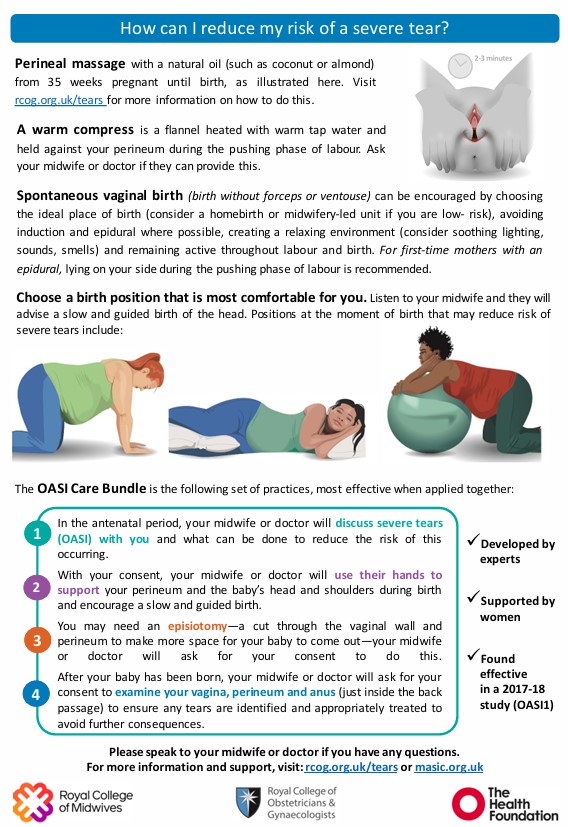
Perineal massage
It is recommended that you practice perineum (area between your vagina and back passage) massage during pregnancy to reduce the risk of a severe tear during birth.
From 35 weeks onwards, daily perineal massage until your baby is born reduces your risk of severe tearing (64% less risk), increases your chances of not tearing at all, reduces the need for episiotomy (13% lower rate), shortens the pushing stage of labour and improves your wound healing after birth.
Translation playlists
My Expert Midwife – How To Do Perineal Massage (youtube.com)
Birth position

- Choose a birth position that is most comfortable for you.
- Write a personalised birth plan which provides information about what you and your birth partner would like during your labour and birth
- Birth positions that will reduce your risk of severe tears include kneeling, all fours, or lying on your side. If you have an epidural, then laying on your side for the whole of the second stage (from when your cervix is fully dilated) has been shown to increase the likelihood of a spontaneous birth.
- Remaining upright and active throughout labour and birth promotes spontaneous birth (birth without forceps or ventouse)
Warm compress
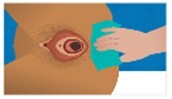
- Your Midwife or Doctor can gently hold a warm compress (period pad, flannel or swab soaked in warm tap water) against your perineum, as the baby’s head becomes just visible, and the perineal tissues start to stretch. Birth partners can offer to hold the compress in place.
- Warm compresses can help to reduce chances of severe tears (1.9% vs 5.8%), reduce the need for an episiotomy (10.4% vs 17.1%) and improve the chances of not needing stitches at all (22.4% vs 15.4%).
Slow and guided birth
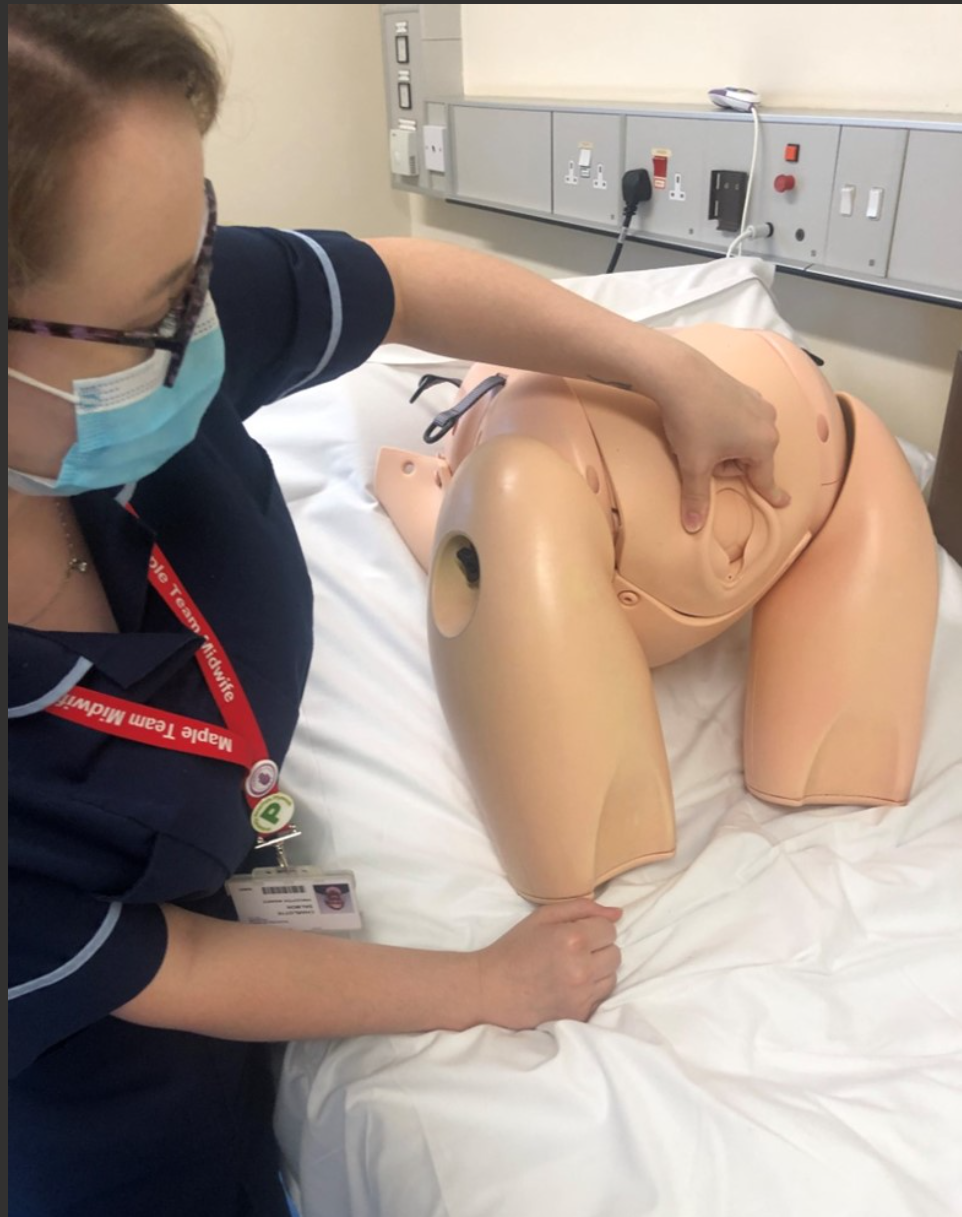
- A slow and guided birth of your baby’s head can reduce your chance of having a severe tear. Slowing the last 20 seconds before your baby’s head is born gives your perineum time to stretch slowly. Your Midwife or Doctor will communicate with you to ensure that you have a slow and guided birth, by encouraging breathing or panting through your contraction.
- Your Midwife or Doctor can support your perineum during birth. This is called manual perineal protection, or a ‘hands on birth’ and is done for a short period during the birth of your baby’s head and shoulders
- Manual perineal protection (MPP) can be done in most positions except in water births or when on a birthing stool, as the Midwife cannot reach.
- MPP can help to reduce the severity of tearing.
- The OASI Care Bundle included MPP and found that this practice when combined as part of a package of care reduced the rates of severe tear by 20%.
Encouraging a spontaneous birth & creating the right birth environment for you
Few birth outcomes, including instrumental birth can be predicted during pregnancy.
This section highlights the research about what choices you can make to encourage a spontaneous birth and reduce your risk of a severe tear.
Creating the right birth environment for you is about personalized care. Write down your birth preferences and choices for the things that will make you feel safe and supported, such as lighting, music, birth partner involvement, pain relief or use of water. Take time to discuss these with your midwife so that you and your birth partner(s) feel supported and in control of your labour and birth.
- Remaining upright and active throughout labour and birth promotes spontaneous birth.
- Language. Your maternity team will try to use terms that put women at the centre. Find out more about maternity professionals’ use of language as part of the RE:Birth project
- Music helps to create a calm environment and can reduce anxiety and pain. Bring your own playlist.
- Choose a birthing partner who will make you feel at ease
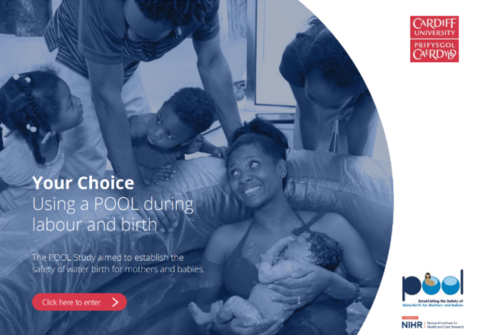
- If you are interested in learning more about waterbirth click on the POOL study results here:
Planning where to have your baby
Planning where to have your baby is an important decision.
Local maternity unit websites show what is available in Devon. Consider if and how far you are able to travel as a neighbouring unit may offer a wider choice. It is important to know however that if you have an emergency the ambulance will take you to your nearest unit.
When making a decision about where to give birth please consider: your medical history, distance from your nearest unit as well as you and your baby’s health during pregnancy.
Your choices may change as birth approaches. The final choice is yours and we would encourage conversations with your midwife or obstetrician.
Depending on what your healthcare provider offers you can choose to give birth in one of four places:
- at home
- a midwifery unit; 1. freestanding midwifery unit (FMU) -no consultant services on site. 2. alongside midwifery unit (AMU), which is next to a hospital with an obstetric unit.
- a hospital obstetric unit.
2024 update-Please note due to staffing shortages some midwifery led units have been unable to offer their services or homebirths, and due to recent ambulance delays some units have recommended birth within their units. Speak to your midwife for local updates.
If your pregnancy is high risk or you have pregnancy complications your midwife or obstetrician is likely to recommend a obstetric hospital birth. We do not have enough evidence to suggest the research below is applicable to this group of women and their babies.
For healthy women without additional risk factors or pregnancy complications:
- Planning to birth at home or in a midwifery unit increases the likelihood of a straightforward vaginal birth than women planning birth in an obstetric unit.
- Planning to give birth in a midwifery unit is a particularly suitable option for low risk, healthy women having their first baby because the rate of intervention is lower and there is no evidence that the outcome for the baby is different compared with an obstetric unit.
- Women with medical conditions prior to pregnancy or where they or their baby develop complications during pregnancy may be advised to give birth in a consultant hospital unit with additional services onsite for them and/or their baby.
(NICE 2023 NG235, Birthplace study 2011)
Please read links below for further information.
Information for healthy, low-risk women having their first baby
Information for healthy, low-risk women who have had a baby before
Making decisions about your individual care
Using the B.R.A.I.N acronym can help you to discuss ideally antenatally about any care or procedure that may be recommended during birth, or you would like to put in your birth plan.
You, your midwife or doctor may want to use the BRAIN framework to help guide you.
B – What are the Benefits?
R – What are the Risks?
A – What are the Alternatives?
I – What does your Intuition (gut) say about what’s right for you?
N – What would happen if I said No or Not now (could I have some time to think about it)?
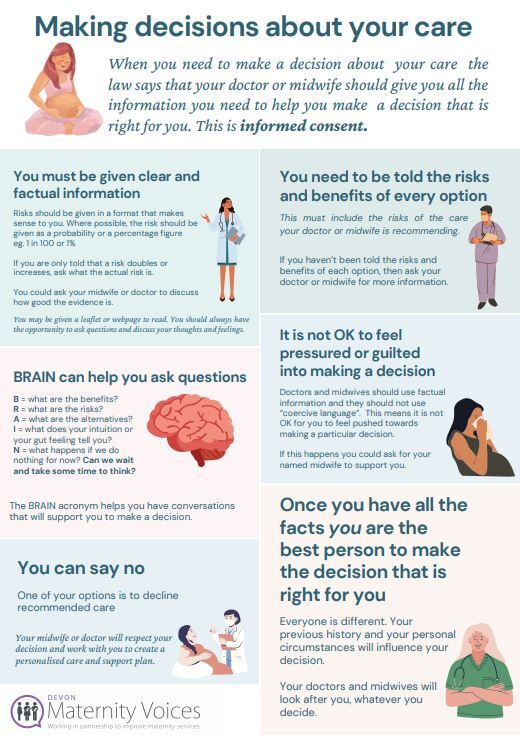
Many thanks to Devon Maternity and Neonatal Voices Partnership for use of their birth choices poster.
See here for more information on informed consent and choice around birth.